Overview
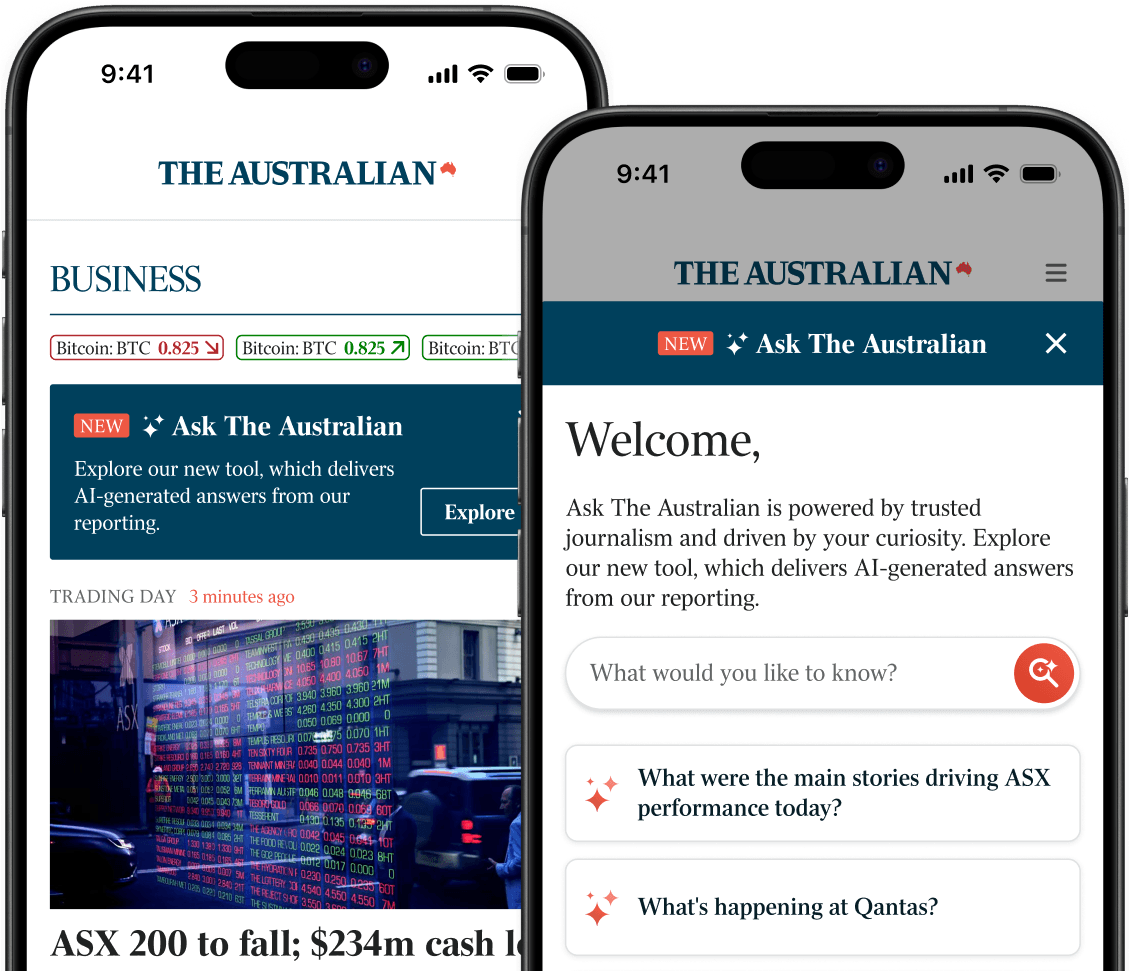
Ask The Australian is a generative AI search experience built for the Business section of The Australian. It combines AI-generated answers with sourced journalism, giving subscribers a faster, smarter way to find insight without sifting through search results..
The challenge
The Australian has a highly engaged, opinionated readership with high expectations. One clear friction point was content discovery. Valuable journalism was getting buried and the existing search experience wasn't helping readers find it. Prior to the project, a survey of over 500 subscribers confirmed it: faster, smarter content discovery was the top personalisation priority.
This mattered most for two subscriber groups:
Business leaders and entrepreneurs who need reliable information quickly. Skew younger: 24% Gen Z, 36% Millennials.
Experienced investors after detailed, fact-based research without sifting through pages. Predominantly Gen X, aged 45–65.
The project came with clear constraints. The brand identity needed to be respected, legal guardrails ruled out financial advice and personally identifiable information, and the first iteration was scoped to web only. Anything technically out of reach was documented for future iterations.
Defining the experience
Early on the stakeholders made a call that this was a Gen AI search, not a chatbot experience. The goal was to help people find answers quickly, understand where those came from, and keep reading. That distinction shaped the information architecture, the interaction model, and the way content was presented.
Gen AI search, not a chatbot
A chatbot has a conversation. Gen AI search generates a single, direct answer from a trusted source and gets you on your way. No back and forth, no open ended dialogue.
Built on verified journalism
Rather than drawing from the open web, Ask The Australian pulls answers from The Australian's archive. Every response is sourced, cited and grounded in credible reporting.
Initial experience mapping
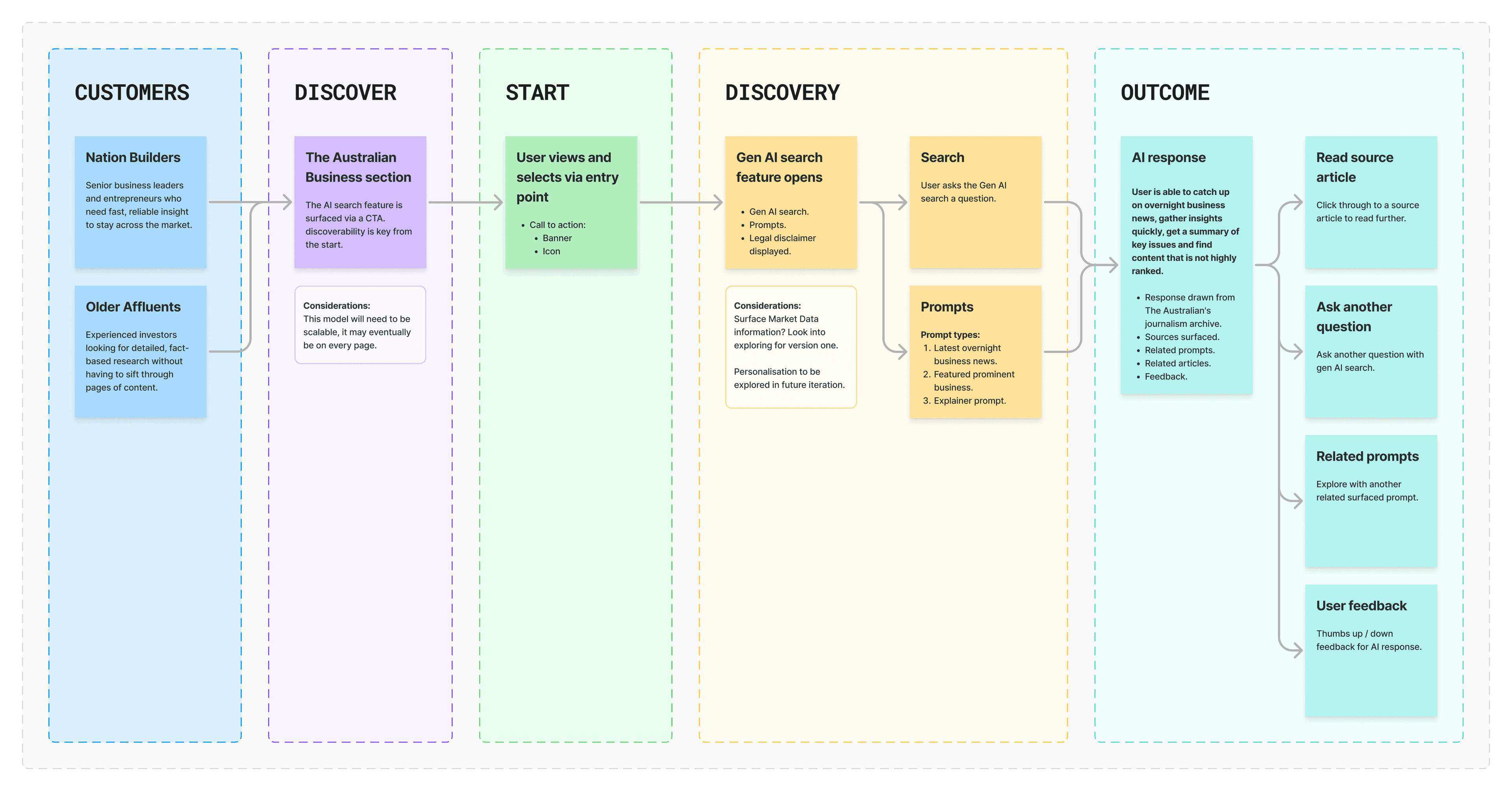
From there I mapped out the core journey, covering how users would discover the feature, what they would encounter, and where they could end up.
Early concepts
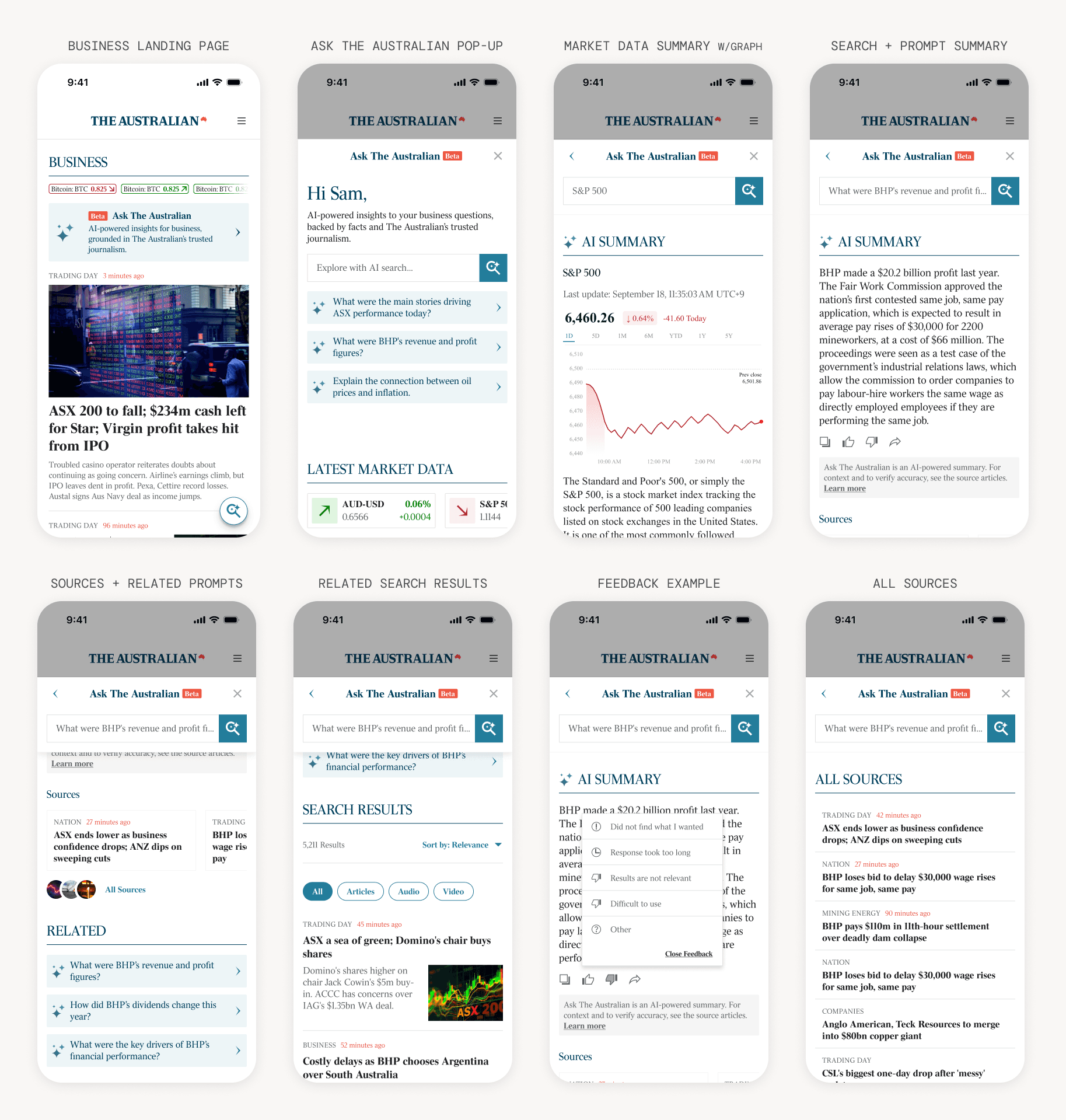
The first round of designs focused on the core journey within The Australian's established brand.
Research & findings
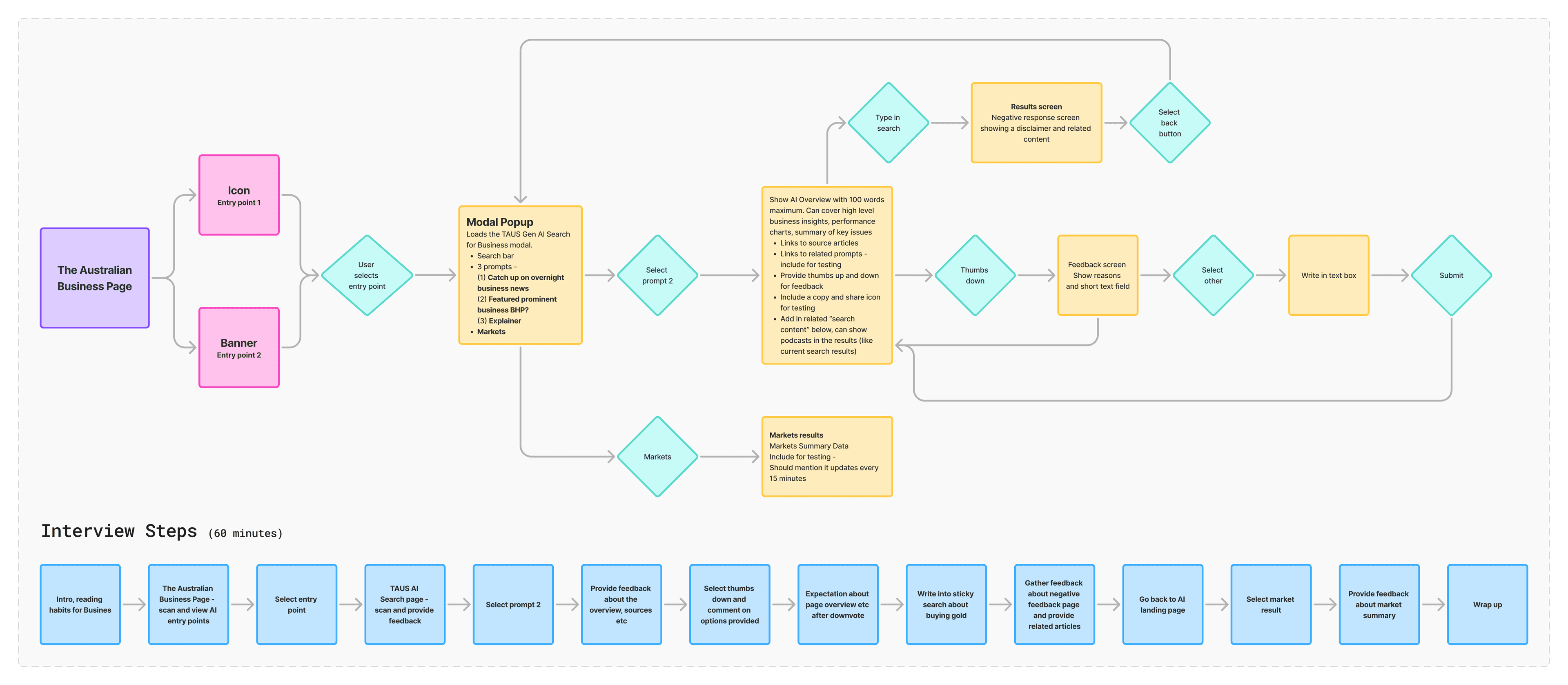
With the first round of designs complete, I worked alongside a Senior UX Designer to run one on one user interviews with subscribers from both audiences. Before sessions began, a testing flow was mapped to define the exact paths participants would move through and structure the research around the right questions.
One theme came through consistently: users preferred the AI feature over traditional keyword search. It saved time and surfaced content they wouldn't have found otherwise.
Key Findings
Users trusted the AI because it drew from The Australian's journalism rather than the open web. But trust was fragile. Summaries that felt incomplete eroded confidence quickly.
Users wanted charts, graphs and customisable timeframes, not descriptive text. If it couldn't be built to that standard, it shouldn't be there.
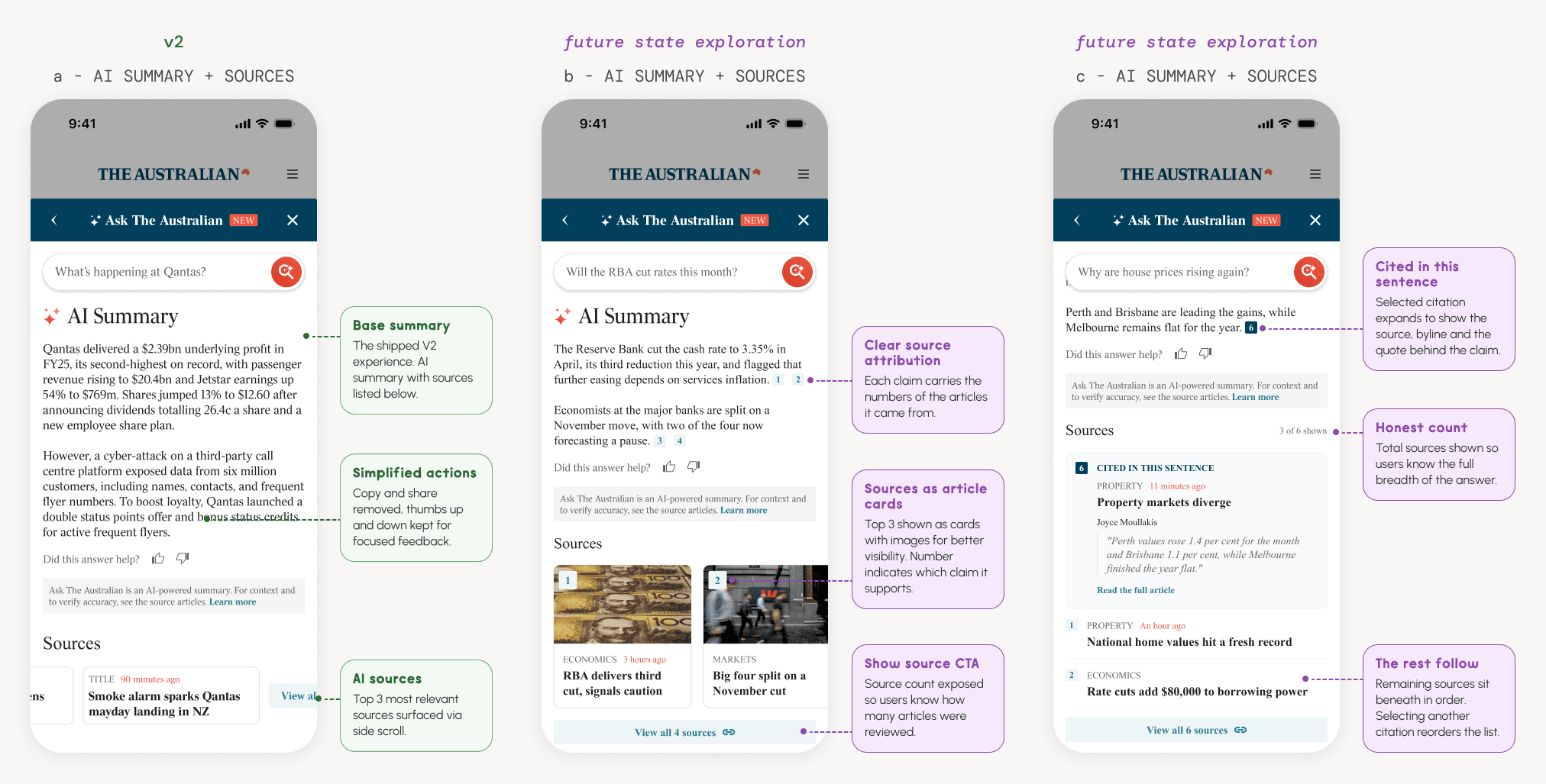
Sources were valued, but users wanted attribution linked directly within the summary itself.
Users saw related prompts as a natural way to keep exploring.
The banner didn't create enough urgency, and the floating icon alone didn't communicate the AI function.
The greeting set expectations the product couldn't meet as it wasn't in scope, so it was removed.
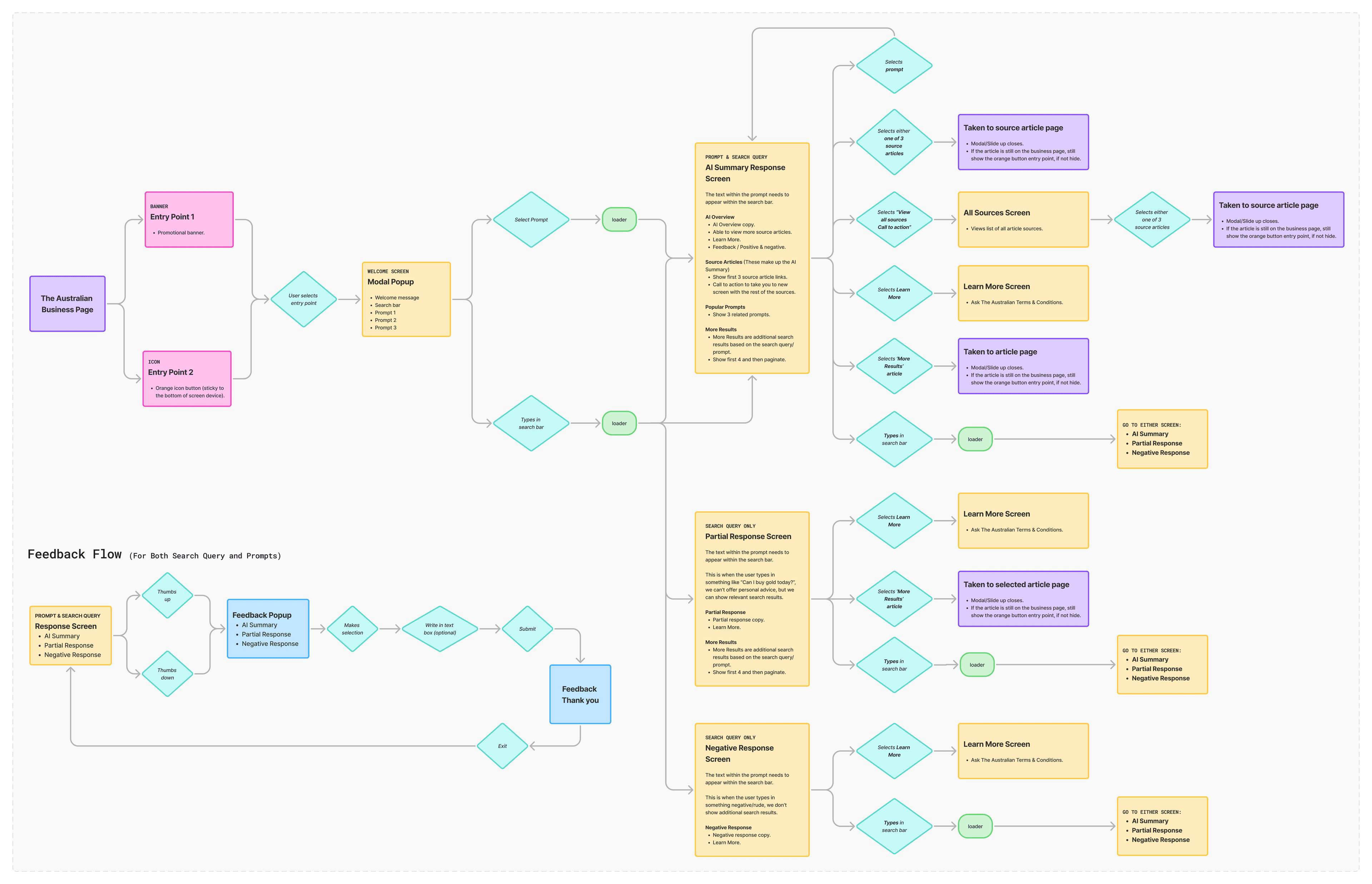
Refined user flow
With the research synthesised, I updated the user flow to map every response state and exit point before moving into V2 designs.
Iteration
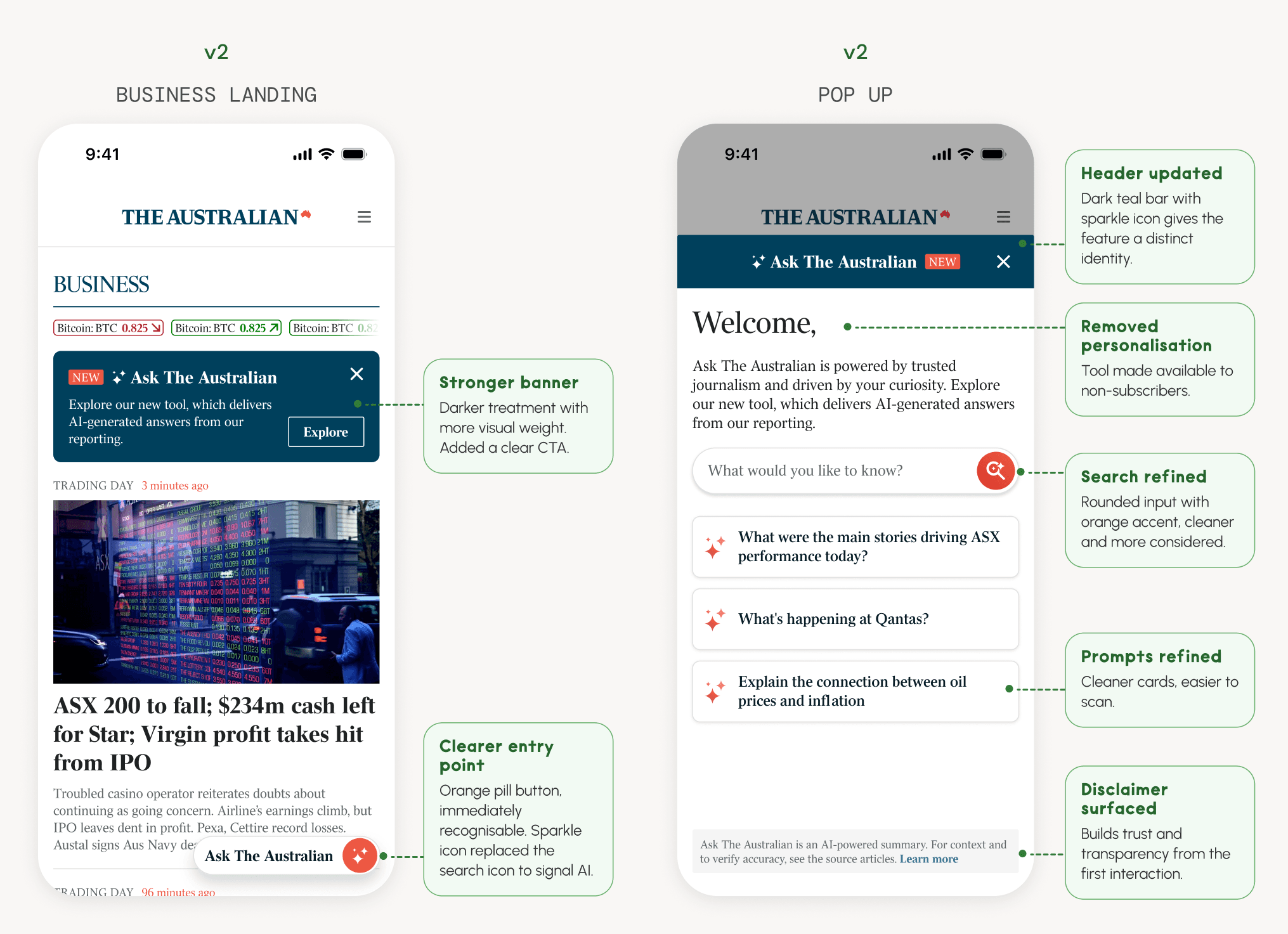
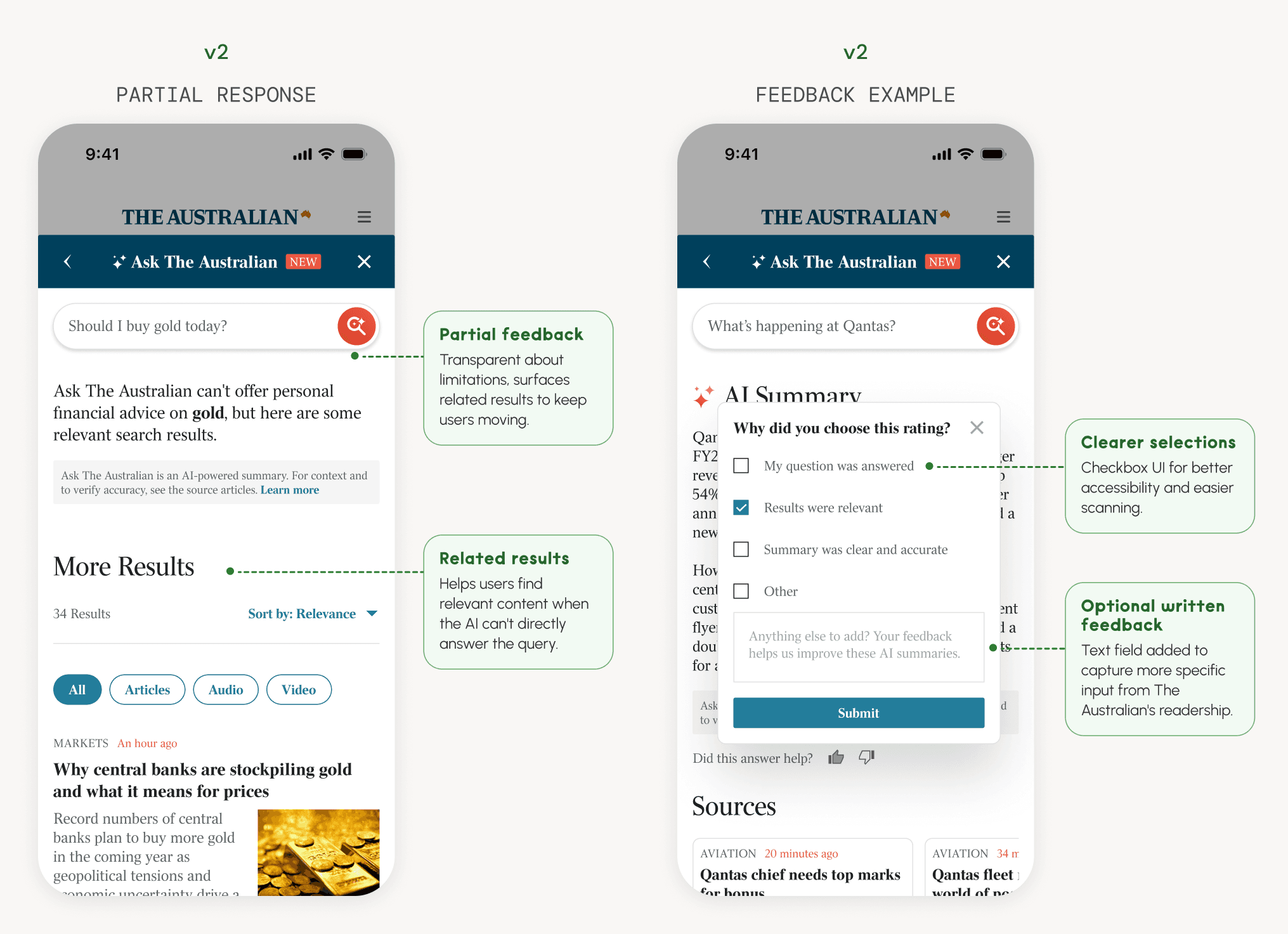
Research informed a focused set of design decisions. Rather than changing everything, I focused on the moments that mattered most: how users discovered the feature, what they encountered when they opened it, and how the AI communicated its sources.
I also refined the visual styling throughout, simplifying the UI to give the feature a more polished and distinct feel within The Australian's brand.
Source attribution came through strongly in research but couldn't be built within scope. The first screen shows the shipped V2 experience. The following two are future state explorations of what inline citation could look like.
Prototype
The prototype covers the end to end experience: launching the feature, exploring suggested prompts, running a search query and interacting with the feedback flow.
Reflection
Ask The Australian launched in April 2026 as News Corp Australia's first AI-powered search experience. Post-launch data wasn't available at time of writing.
Getting designs in front of real subscribers early and feeding those insights directly back into the product.
Designing for trust isn't just about accuracy. For an audience this sceptical, every small decision either builds or erodes it.
I'd have pushed harder on source attribution earlier. It came through strongly in research, couldn't be built within scope, and is the clearest next step for the feature.